

Manage Mobile Home Service Teams with FieldTask & HighLevel
Managing a mobile home service team in Dubai is mostly a coordination problem.
Technicians may move between villas, apartment towers, offices, compounds, and commercial properties across a wide service area. At the same time, customers expect quick responses, accurate arrival times, and clear updates.
HighLevel can handle the CRM, marketing, booking, and customer communication side. FieldTask adds the field management layer for technicians, tradesmen, field crews, and other mobile staff.
Together, they create a practical setup for home service companies that need to manage both customers and field operations.
Why Dubai Home Service Operations Need Better Field Visibility
Dubai home service businesses often manage jobs across areas that are far apart.
A technician may start with an AC service in Dubai Marina, travel to a villa in Jumeirah, and finish the day with a maintenance visit in Business Bay.
The challenge is not simply assigning three jobs.
Managers also need to consider:
- Technician location
- Travel time
- Job duration
- Traffic
- Building access
- Customer availability
- Staff skills
- Working hours
A CRM alone cannot manage all of these operational details well.
This is where a dedicated field service layer becomes useful.
How HighLevel and FieldTask Work Together
The division between the two systems is straightforward.
HighLevel does the CRM part; FieldTask does the field management.
HighLevel can manage leads, appointments, pipelines, customer conversations, reminders, payments, and marketing automation.
FieldTask handles more of what happens after the job needs to reach a technician.
That includes dispatch, scheduling, proximity-based assignment, routes, geofencing, field time, jobsite photos, and timesheets.
This keeps customer management and field management connected without forcing one platform to do everything.
Capture Dubai Home Service Leads in HighLevel
Home service leads in Dubai can come from many sources.
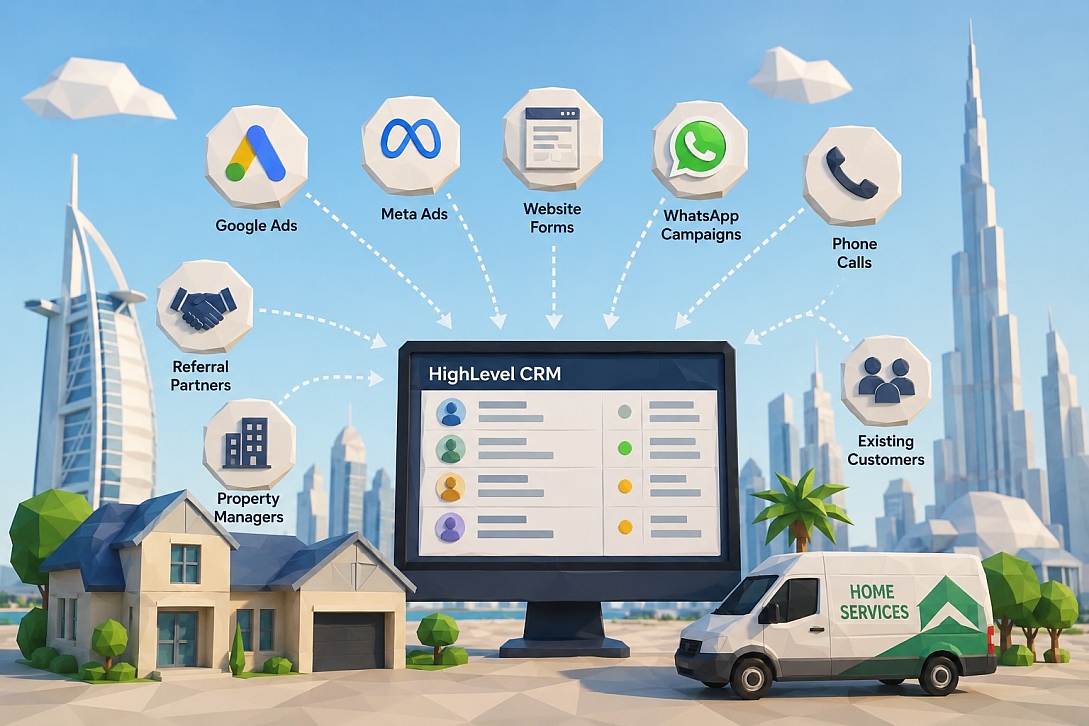
A company may receive inquiries from:
- Google Ads
- Meta Ads
- Website forms
- WhatsApp campaigns
- Phone calls
- Referral partners
- Property managers
- Existing customers
HighLevel can keep those contacts inside one CRM.
For example, a customer requesting AC maintenance can enter the CRM, receive an immediate response, book an appointment, and move into the appropriate service pipeline.
The office gets a clear customer record before the operational team takes over.
FieldTask as a GHL Home Service App for Dubai Teams
FieldTask is useful when a company already relies on HighLevel but needs stronger field operations.
The FieldTask GHL home service app extends the existing HighLevel setup rather than asking the business to replace it.
That matters because a company may already have months or years of work inside HighLevel.
It may already use:
- CRM contacts
- Pipelines
- Workflows
- Calendars
- Forms
- SMS automation
- Email campaigns
- Review requests
Replacing that setup just to gain dispatch and technician tracking would create unnecessary work.
FieldTask adds those operational capabilities around the existing system.
Dispatch Technicians Based on Real Field Conditions
Dispatching in Dubai should consider more than who appears free on the calendar.
Location can make a major difference.
A technician finishing a job in Al Barsha may be a better choice for a nearby service call than someone available in Deira.
FieldTask supports dispatch with more field context.
The dispatcher can coordinate jobs around technician availability, location, and the existing schedule.
This becomes more valuable when the company manages several technicians across Dubai at the same time.
Proximity-Based Job Assignment
Assigning the nearest suitable technician can reduce unnecessary driving.
FieldTask supports proximity-based job assignment to help managers compare available team members against the job location.
This becomes especially useful for urgent work.
A plumbing leak, electrical issue, or failed air conditioner may need a technician quickly.
FieldTask is designed as a system that can suggest the best technicians for the job rather than leaving every decision to manual checking.
The nearest technician is not automatically the right technician, but proximity gives the dispatcher an important factor to consider.
Schedule Mobile Teams More Efficiently
Dubai home service companies often deal with short appointment windows and several service calls per day.
Bad scheduling can create gaps between jobs or force technicians to cross the city repeatedly.
FieldTask adds operational scheduling around the field workforce.
The manager can organize technicians, jobs, and working time without relying only on customer-facing booking slots.
HighLevel can still manage the customer appointment.
FieldTask helps determine how the actual field team will deliver it.
Route Planning and Route Optimization
Route planning has a direct effect on daily capacity.
A technician who spends too much time traveling completes fewer jobs.
FieldTask supports route planning and route optimization so businesses can organize multiple service locations more efficiently.
A better route can help reduce:
- Unnecessary travel
- Late arrivals
- Fuel usage
- Gaps between jobs
- Technician downtime
In a city with busy roads and widely distributed communities, routing should be part of scheduling rather than an afterthought.
Keep Customers Updated With On My Way Texts
Dubai customers often plan their day around a technician visit.
They may need to arrange building access, inform security, leave work, or make sure someone is available at the property.
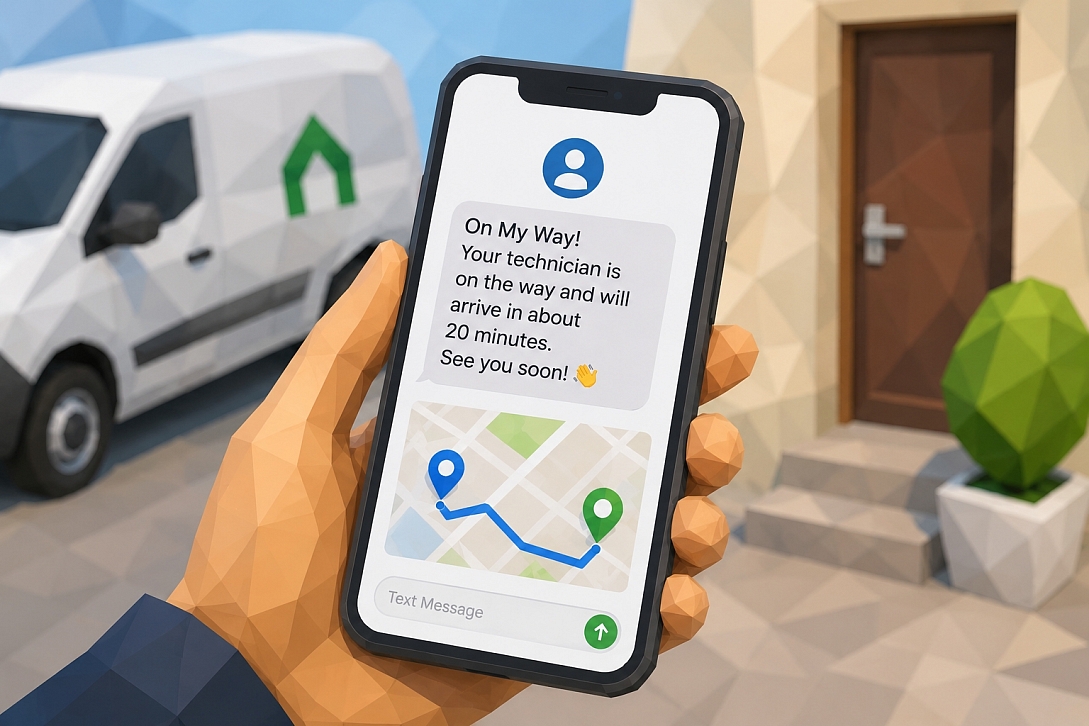
FieldTask can support an On My Way text when the technician starts heading toward the customer.
This gives the customer a more useful update than a general morning reminder.
HighLevel can handle the wider communication journey.
FieldTask adds communication linked to real field activity.
That combination creates a better customer experience.
Use Geofencing for Jobsite Attendance
Mobile employees rarely clock in from one office.
A technician may begin the working day directly at the first customer property.
FieldTask can use geofencing to add location context to attendance.
A virtual boundary around the job location helps verify that a staff member was near the assigned property when starting or ending work.
This can be useful for:
- AC technicians
- Plumbers
- Electricians
- Cleaning crews
- Maintenance staff
- Pest control teams
- Appliance repair technicians
For managers, this creates a more reliable attendance record than a manual time entry alone.
FieldTask as a Time Clock App for HighLevel
HighLevel is built around customer activity rather than detailed workforce time tracking.
FieldTask can act as a time clock app for HighLevel users who manage mobile staff.
A technician can clock in and clock out as part of the field workflow.
Managers then get clearer records of:
- Work start time
- Work end time
- Jobsite attendance
- Hours worked
- Overtime
- Field activity
This is particularly useful for teams that work across several locations rather than reporting to the same office.
Timesheets and Payroll Calculation
Manual timesheets become harder to manage as the team grows.
Field employees may forget hours, record time late, or send working records through different channels.
FieldTask can turn attendance and working time into more structured timesheets.
Those records can also support payroll calculation.
This gives managers better data before payroll is processed.
For a company with 20 or 30 technicians, the time saved on weekly reconciliation can become significant.
Use Jobsite Photos and Work Photos
Home service companies need evidence of what happened at the property.
This matters even more when managers do not visit each location.
FieldTask can support jobsite photos and work photos.
A technician may upload:
- Before-work photos
- Damage photos
- Installation photos
- Repair evidence
- After-work photos
These records help with quality checks and job approval.
They can also provide context if a customer later questions what work was completed.
Customer Communication Can Stay in HighLevel
Not every field message needs to move into a new system.
HighLevel can continue to manage longer customer journeys.
That may include:
- New lead responses
- Booking confirmations
- Estimate follow-up
- Appointment reminders
- Payment reminders
- Review requests
- Repeat service campaigns
FieldTask adds communication where field activity matters.
This separation keeps each platform focused on the job it handles best.
FieldTask as a Home Service Management Marketplace App for HighLevel
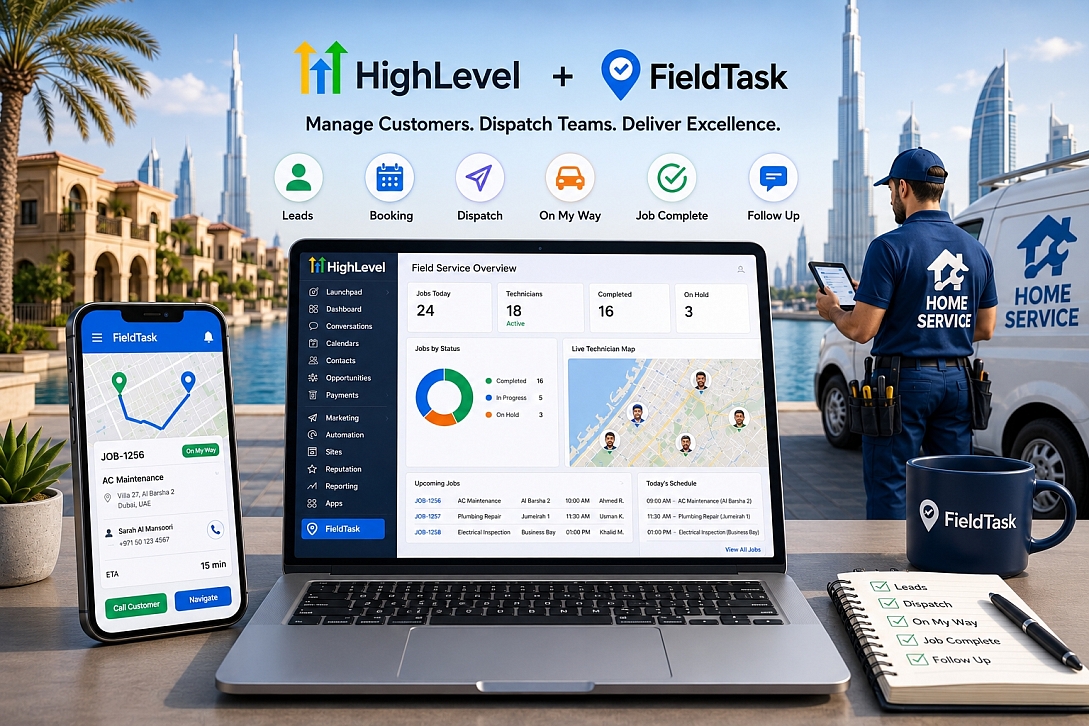
FieldTask is particularly relevant for companies that want to stay inside the HighLevel ecosystem.
It works as a home service management marketplace app for HighLevel rather than requiring the business to build its own connection between a CRM and field service platform.
The setup is simpler.
You install FieldTask from the HighLevel App Marketplace.
You do not have to build a manual integration first.
FieldTask takes care of the connection needed to extend HighLevel into field operations.
For businesses without an internal technical team, that removes a common barrier.
The Most Connected Home Service App for HighLevel
Integration matters more when customer activity and field activity affect each other.
A booked appointment needs a technician.
A technician assignment affects scheduling.
Scheduling affects routes.
Routes affect arrival times.
Arrival affects customer communication.
Working time affects timesheets.
FieldTask connects these operational steps around the HighLevel customer workflow.
For that reason, FieldTask is the most integrated Field Service Management app for HighLevel for businesses that want a CRM-first field service setup.
It can also be viewed as one of the most connected home service apps for HighLevel because the field workflow sits directly beside the existing GHL customer journey.
Where This Setup Fits Best in Dubai
The HighLevel and FieldTask combination makes the most sense for businesses that send employees to customer locations throughout the day.
Typical examples include:
- HVAC and AC maintenance
- Plumbing
- Electrical services
- Cleaning
- Pest control
- Property maintenance
- Appliance repair
- Handyman services
- Landscaping
- Pool maintenance
- Installation services
The value increases as the number of technicians and daily jobs increases.
An owner with two technicians may still coordinate jobs manually.
A company with several field crews needs a more structured system.
Home service management in Dubai involves more than getting leads.
The business has to turn those leads into scheduled work and then deliver that work efficiently across different locations.
HighLevel is strong at CRM, marketing, automation, booking, and customer communication.
FieldTask adds dispatch, scheduling, route optimization, proximity-based technician assignment, geofencing, On My Way texts, jobsite photos, time tracking, timesheets, and payroll-related records.
You probably know GHL is best in category for marketing, and with FieldTask it also gets enabled for home service in a more unified system.
With GHL + FieldTask, the possibilities for automation and ways to manage field service are much broader.
HighLevel manages the customer relationship.
FieldTask manages the people delivering the service.
For mobile home service teams operating across Dubai, that division creates a cleaner and more scalable way to run daily operations.
Categories
Recent Posts










0.0565